
 English
 中文简体
中文简体 한국어
한국어 عربى
عربى

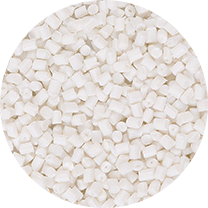
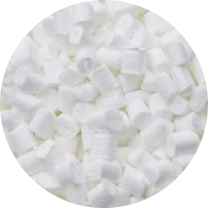
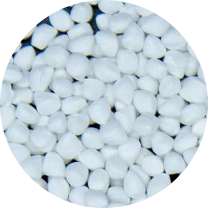
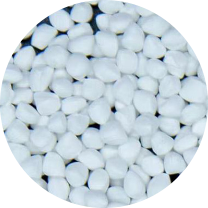
Injection White Masterbatch is a concentrated compound of high-opacity titanium dioxide (TiO2) dispersed in a carrier resin — formulated specifically for injection moulding processes. It delivers bright, uniform white colour, UV protection, and surface opacity to moulded parts at loading rates of 2–5%, replacing the need to handle raw TiO2 powder on the production floor. Choosing the right grade directly controls part whiteness, cycle time, mechanical retention, and long-term weathering performance.
Why Injection Moulding Demands a Dedicated White Masterbatch Grade
Not all white masterbatches perform the same in injection moulding. The high shear rates inside an injection barrel — typically 1,000–10,000 s⁻¹ at the screw tip — and rapid temperature cycling between 180°C and 320°C (depending on base resin) place specific demands on the masterbatch formulation that film or blow moulding grades are not designed to meet.
- Viscosity matching: The carrier resin in an injection-grade masterbatch must have a melt flow index (MFI) that is 1.5–3x higher than the base resin, ensuring rapid dispersion under high shear without creating cold spots or unmelted pigment agglomerates.
- Thermal stability: TiO2 can catalyse polymer degradation at processing temperatures above 260°C if not surface-treated. Injection grades use alumina- or silica-coated rutile TiO2 that remains stable up to 320°C.
- No moisture sensitivity: Film grades often contain slip or anti-block additives that outgas in a closed injection mould, causing surface blistering. Injection grades are additive-clean or use non-volatile processing aids only.
- Fast colour homogenisation: The short residence time in an injection barrel (typically 2–8 minutes) means the masterbatch must fully disperse within one or two screw rotations — this requires pre-dispersed pigment at the sub-micron level, not simply blended powder.
TiO2 Content and What It Means for Your Parts
Injection white masterbatches are commercially available across a wide TiO2 loading range. The correct choice depends on final part wall thickness, required opacity, and cost targets:
| TiO2 Loading in Masterbatch | Typical Let-Down Ratio | Effective TiO2 in Part | Best For |
|---|---|---|---|
| 50% | 2–3% MB in base resin | 1.0–1.5% | Thin-wall parts (0.5–1.5 mm), high-gloss cosmetic caps |
| 60% | 3–4% MB in base resin | 1.8–2.4% | Consumer goods, household appliance parts (1.5–3 mm wall) |
| 70% | 4–5% MB in base resin | 2.8–3.5% | Thick-wall technical parts, packaging with opacity requirement |
| 75–80% | 2–3% MB in base resin | 1.5–2.4% | Cost-optimised high-volume production where lower let-down is preferred |
A general rule: 1% TiO2 by weight in the finished part provides a contrast ratio (opacity) of approximately 0.85–0.92 over a black substrate for a 1 mm PP wall, measured per ISO 2814. Parts thicker than 3 mm typically reach full opacity at 1.5% TiO2, so increasing beyond that point adds cost without optical benefit.
Compatible Carrier Resins and Base Polymer Matching
The carrier resin in the masterbatch must be compatible with — and ideally the same polymer family as — the base resin being moulded. Mismatched carriers are the most common cause of white streaks, delamination, or reduced impact strength in moulded parts.
| Base Resin Being Moulded | Recommended Carrier | Caution |
|---|---|---|
| Polypropylene (PP) | PP homopolymer or copolymer | Avoid PE carrier — causes surface haze and reduced weld-line strength |
| ABS | ABS or SAN carrier | PE or PP carrier causes delamination layers visible on cross-section |
| Polystyrene (PS / HIPS) | PS or HIPS carrier | Non-PS carriers reduce impact strength by 15–25% |
| Polyamide (PA6 / PA66) | PA6 carrier, dried to <0.2% moisture | Any non-PA carrier causes splay marks; carrier must be pre-dried at 80°C/4 hr |
| PC or PC/ABS blend | PC carrier or universal high-temp carrier | Processing above 280°C; standard PP/PE carriers degrade and discolour |
| HDPE / LDPE | LLDPE or LDPE carrier | PP carrier acceptable only if part is non-structural |
Key Processing Parameters for Injection Moulding with White Masterbatch
Correct processing settings prevent the most common white masterbatch defects: streaking, yellowing, uneven distribution, and surface gloss variation.
- Back pressure: Set between 5–15 MPa. Higher back pressure improves pigment dispersion but increases shear heat. For engineering resins above 280°C, keep back pressure at the lower end to avoid thermal degradation of the carrier.
- Screw speed: 60–120 RPM is the normal working range. Speeds above 150 RPM with a high-TiO2 masterbatch can generate localised overheating and yellowing at the screw tip.
- Barrel temperature profile: The rear zone should be set 10–20°C lower than the front zone to allow gradual melting of the masterbatch pellets before the main compression and mixing zones.
- Drying: Most PE- and PP-carrier white masterbatches do not require drying. However, if stored in humid conditions (>70% RH), surface moisture absorption can cause splay marks — 2 hours at 70°C in a dehumidifying dryer resolves this.
- Purging between colour changes: White masterbatch residue in a barrel is more persistent than most colours due to the high TiO2 loading. Use a commercial purging compound at 110–120% of barrel volume before switching to a dark colour.
Whiteness Index, Yellowness Index, and How to Measure Them
Two instrumental measurements define the optical performance of a white injection moulded part and should be specified in any masterbatch procurement document:
| Measurement | Standard | Target for Bright White | What Drives Failure |
|---|---|---|---|
| Whiteness Index (WI) | ASTM E313 / CIE | WI > 80 (consumer); WI > 90 (premium) | Low TiO2 loading, poor dispersion, inadequate opacity |
| Yellowness Index (YI) | ASTM D1925 / E313 | YI < 3 (standard); YI < 1.5 (premium) | Thermal degradation of carrier or polymer; non-rutile TiO2 grade |
| L* value (lightness) | CIE L*a*b* | L* > 95 | Insufficient TiO2, dark pigment contamination |
| Opacity / Contrast Ratio | ISO 2814 | > 0.95 over black substrate | Wall too thin, TiO2 too low, anatase grade used instead of rutile |
Rutile TiO2 (refractive index 2.71) consistently outperforms anatase TiO2 (refractive index 2.52) in both whiteness and UV durability, and is the standard for any injection moulded part with an outdoor or light-exposed service life. Anatase grades are only justified for cost-critical indoor applications with no UV requirement.
UV Stabilisation: When to Add It and What Loading to Specify
TiO2 alone does not protect the polymer matrix from UV degradation — it scatters and reflects UV but does not absorb it. Parts used outdoors or in high-UV environments need HALS (Hindered Amine Light Stabilisers) and/or UV absorbers added either in the masterbatch or as a separate additive masterbatch.
- For PP parts with 12-month outdoor service life: HALS loading of 0.15–0.25% in the finished part is the standard starting point per ISO 4892-2 accelerated weathering data.
- For PE parts with 24-month outdoor life: HALS at 0.3–0.5% combined with a UV absorber (e.g. benzotriazole type) at 0.1–0.2%.
- For automotive exterior PP parts (5-year warranty): HALS at 0.5–0.8% with a UVA at 0.2–0.3% — typically supplied as a combined UV masterbatch dosed alongside the white masterbatch.
Some injection white masterbatches are available as "UV white" grades with HALS pre-incorporated, simplifying dosing on the production line. Confirm the HALS type is non-extractable (polymeric HALS) for food-contact or skin-contact applications.
Food-Contact and Regulatory Compliance for Injection White Masterbatch
White masterbatch used in injection moulded food packaging, kitchen utensils, or medical device housings must comply with applicable regulations. Key frameworks include:
- EU Regulation 10/2011: Plastics materials and articles in contact with food. TiO2 is listed as an authorised additive (FCM substance No. 744). Carriers and processing aids must also be from the positive list.
- FDA 21 CFR: For US food-contact applications — the carrier resin and all additives must comply with the relevant subpart (e.g. 21 CFR 178.3297 for colorants).
- REACH (EC 1907/2006): Suppliers must provide a Safety Data Sheet and confirm no SVHC (Substances of Very High Concern) above 0.1% w/w in the masterbatch.
- RoHS / heavy metal limits: The TiO2 pigment must meet EN 71-3 and similar standards; confirm the product is free from lead, cadmium, and hexavalent chromium.
A compliant supplier provides a Declaration of Conformity (DoC) with each batch, referencing the specific regulation, test migration data, and the identity of all substances used. Batch-level traceability with a Certificate of Analysis (CoA) is the minimum for regulated applications.
Typical Defects and How to Diagnose Them
| Defect Observed | Most Likely Cause | Corrective Action |
|---|---|---|
| White streaks or swirl marks | Poor dispersion; masterbatch MFI too low vs base resin | Increase back pressure 5–10 MPa; switch to higher-MFI masterbatch grade |
| Yellowish tint on parts | Thermal degradation — processing temp too high or residence time too long | Reduce barrel temp by 10–15°C; reduce shot-to-shot cycle time; check screw speed |
| Uneven opacity (patchy) | Inconsistent blending of masterbatch with base resin in hopper | Use gravimetric dosing unit instead of tumble blending; increase back pressure |
| Delamination layers | Carrier resin incompatible with base polymer | Source a masterbatch with same-polymer carrier |
| Surface splay / silver streaks | Moisture in masterbatch or PA/PC base resin not dried adequately | Dry masterbatch 2 hr at 70°C; dry PA or PC base resin per supplier spec |
| Reduced impact or tensile strength | Overloading TiO2 beyond 4% in finished part; incompatible carrier | Reduce let-down ratio; verify carrier compatibility with mechanical test |