

 English
 中文简体
中文简体 한국어
한국어 عربى
عربى

NEWS
Home / News / Industry News / Engineered Longevity: Carbon Black Masterbatch UV Stabilization Mechanism and Antioxidant Systems


Engineered Longevity: Carbon Black Masterbatch UV Stabilization Mechanism and Antioxidant Systems
Article Directory
- 1 The Dual Shield: Understanding the Carbon Black Masterbatch UV Stabilization Mechanism
- 2 Quantifying Lifespan: Outdoor Durability of Carbon Black Masterbatch
- 3 Designing the Anti-Degradation System: Carbon Black Masterbatch Antioxidant System Design
- 4 Technical Specification for Long-Term Outdoor Procurement
- 5 Frequently Asked Questions (FAQ)
- 5.1 1. Is carbon black alone enough for long-term outdoor UV protection?
- 5.2 2. What is the minimum carbon black concentration for effective UV protection?
- 5.3 3. What is HALS and why is HALS effectiveness in Carbon Black Masterbatch important?
- 5.4 4. How is the predicted lifespan confirmed in a laboratory?
- 5.5 5. Does the choice of carbon black grade impact UV performance?
In applications demanding extended outdoor performance—such as pipes, geosynthetics, and agricultural films—the stability of the polymer matrix against photo-oxidative degradation is paramount. The performance of the Carbon Black Masterbatch is not merely defined by its blackness, but by its sophisticated dual-action protection system: physical UV shielding and a complementary chemical antioxidant package. This analysis focuses on the technical specifications required for long-term Outdoor durability of Carbon Black Masterbatch.
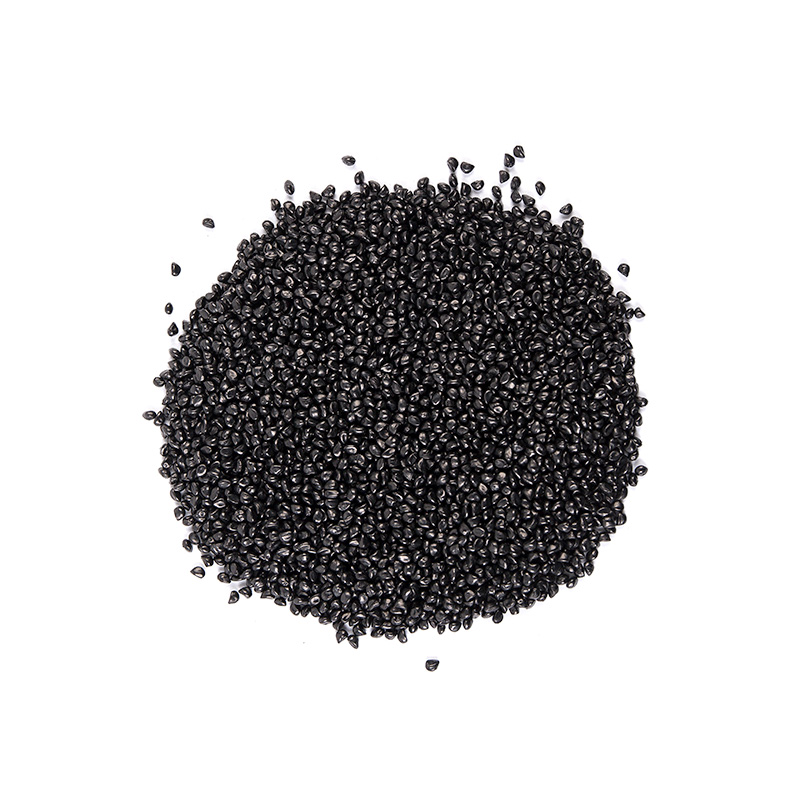
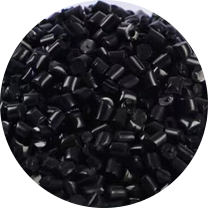
PP Hygienic/Food Grade EVA/ABS/PET Plastic Pellets Black Masterbatch
The Dual Shield: Understanding the Carbon Black Masterbatch UV Stabilization Mechanism
A high-performance Carbon Black Masterbatch achieves weather resistance through two distinct, yet synergistic, mechanisms.
Primary UV Protection: Carbon Black's Role as a Physical Screen
- Absorption and Conversion: Carbon black is a near-perfect absorber of ultraviolet (UV) radiation across the critical 290 nm to 400 nm range. It effectively converts destructive UV energy into harmless heat.
- Radical Scavenging: Beyond physical shielding, carbon black particles act as primary radical scavengers, disrupting the free-radical chain reaction initiated by thermal and photo-oxidation. This requires specific particle sizing (typically $\lt 20$ nm) and high surface area.
Secondary Chemical Protection: The Antioxidant System Design
While carbon black is highly effective, it cannot protect the polymer structure entirely from thermal degradation during processing or from long-term, low-level oxidation. This gap is filled by the engineered Carbon Black Masterbatch antioxidant system design, which chemically neutralizes free radicals and hydroperoxides.
Quantifying Lifespan: Outdoor Durability of Carbon Black Masterbatch
The Outdoor durability of Carbon Black Masterbatch is typically quantified by time-to-failure (e.g., years) based on standard acceleration tests, primarily focusing on the maintenance of critical mechanical properties (e.g., tensile strength, elongation at break) above a specified retention threshold (e.g., 50%).
Relating Carbon Black Concentration to Protection Years (for PE/PP)
For most polyolefins (PE, PP), the standard benchmark for significant UV protection requires a final concentration of 2.0% to 2.5% dispersed carbon black in the final product. The level of protection scales non-linearly with concentration. The required carbon black grade and concentration are critical factors in predicting the Outdoor durability of Carbon Black Masterbatch.
Testing Protocols: Accelerated Weathering Test for Masterbatch
Predicting real-world longevity relies on a rigorous Accelerated weathering test for masterbatch using equipment like Xenon-Arc (ASTM G155, ISO 4892) or Fluorescent UV (ASTM G154) testers. These methods compress years of outdoor exposure into months of laboratory time, allowing B2B buyers to compare expected performance.
Estimated Outdoor Lifespan Comparison Table (PE/PP)
| Final Carbon Black Concentration (%) | Required Pigment Grade | Estimated Outdoor Lifespan (Years) |
|---|---|---|
| $\sim 0.5\%$ (Coloring Grade) | General Purpose | 1 - 3 |
| $\sim 2.0\%$ (UV Protective Grade) | Fine Particle (N330, N220) | 10 - 15 |
| $\sim 2.5\%+$ (Heavy-Duty Protective) | High Surface Area | 15+ |
Designing the Anti-Degradation System: Carbon Black Masterbatch Antioxidant System Design
A robust Carbon Black Masterbatch antioxidant system design must compensate for any synergistic pro-oxidative effects of the carbon black, particularly high surface area grades, and protect the polymer during both high-heat processing and long-term service.
The Necessity of HALS: Evaluating HALS Effectiveness in Carbon Black Masterbatch
HALS (Hindered Amine Light Stabilizers) are essential chemical components. While carbon black screens UV light, HALS works by scavenging free radicals once they are formed, preventing the chain reaction of degradation. HALS is particularly important in thin sections where light penetration is greater. The HALS effectiveness in Carbon Black Masterbatch must be maintained despite the high thermal history of the masterbatch during its compounding.
- Mechanism: HALS regenerates the protecting chemical species over time, providing extended life even after the initial UV exposure.
- Compatibility: Low-molecular-weight HALS are prone to leaching and volatility; high-molecular-weight, polymer-compatible HALS are specified for long-term Outdoor durability of Carbon Black Masterbatch.
Synergistic Effects of Primary and Secondary Antioxidants
The full system design includes primary antioxidants (e.g., hindered phenols, to scavenge peroxy radicals) and secondary antioxidants (e.g., phosphites, to decompose hydroperoxides). Their combined use provides superior protection than either used alone.
Antioxidant Types and Function Comparison Table
| Additive Type | Function | When Used in Carbon Black Masterbatch |
|---|---|---|
| Primary Antioxidants (Phenols) | Scavenges Peroxy Radicals ($ROO\cdot$) | Processing and Long-Term Thermal Stability |
| Secondary Antioxidants (Phosphites) | Decomposes Hydroperoxides ($ROOH$) | Processing (Preventing chain scission during extrusion) |
| HALS | Scavenges Free Radicals, Regenerative UV Protection | Enhancing Carbon Black Masterbatch UV stabilization mechanism |
Technical Specification for Long-Term Outdoor Procurement
B2B buyers should demand certified data showing the final concentration, the specific carbon black grade (e.g., N330), and the type and loading of the Carbon Black Masterbatch antioxidant system design to ensure the product meets the required longevity and performance specifications.
Frequently Asked Questions (FAQ)
1. Is carbon black alone enough for long-term outdoor UV protection?
No. While carbon black is the primary UV shield, a robust Carbon Black Masterbatch UV stabilization mechanism requires complementary chemical stabilizers like HALS and primary/secondary antioxidants to combat thermal and photo-oxidative degradation.
2. What is the minimum carbon black concentration for effective UV protection?
For polyolefins (PE, PP), the industry standard for achieving effective, long-term UV protection is a final concentration of 2.0% to 2.5% of high-surface-area carbon black in the final polymer product.
3. What is HALS and why is HALS effectiveness in Carbon Black Masterbatch important?
HALS (Hindered Amine Light Stabilizers) chemically scavenge free radicals, providing protection even after light has penetrated the polymer. HALS effectiveness ensures the long-term integrity of the plastic, complementing the physical screening of the carbon black.
4. How is the predicted lifespan confirmed in a laboratory?
Lifespan predictions are confirmed using an Accelerated weathering test for masterbatch, such as the Xenon-Arc test (ASTM G155), which simulates years of sunlight, moisture, and temperature fluctuations in a compressed timeframe.
5. Does the choice of carbon black grade impact UV performance?
Yes. Fine particle size (high surface area) carbon black grades, such as N220 or N330, provide superior UV screening and contribute more effectively to the Outdoor durability of Carbon Black Masterbatch compared to larger particle size, lower jetness grades.</HODGEP
prevNo previous article
nextPrecision Pigmentation: Mastering the FPV and Dispersion of Carbon Black Masterbatch

Popular products
The main products include various types of plastic film bags, such as takeout packaging bags, express bags, shopping bags, food composite bags, wrapping films, agricultural film, etc., and disposable dining utensils, such as lunch boxes, knives, forks, spoons, etc.
If you are interested in our products, please consult us
CONTACT DETAILS
- Address : 11-1, No. 600 Tongjiang Middle Road, Xinbei District, Changzhou City, Jiangsu Province
- Whatsapp : 0086-13775276672
- Tel: 0086-13401333666
- Email: [email protected]
QUICK LINK
NEWS CENTER
MOBILE TERMINAL
Copyright © Changzhou Runyi New Material Technology Co., Ltd. All Rights Reserved.
Custom China Antibacterial Masterbatch


 CONTACT US